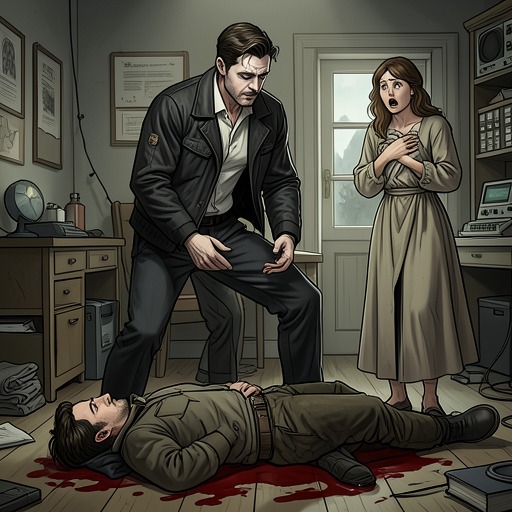
Justice Board
The Vampire Prince’s BrideThe Justice Board is one of the central governing institutions of Stlozyn society, responsible for enforcing law, authorizing arrests, judging extraordinary cases, and determining the consequences of conflicts involving scientific authority, human abduction, and cross-species pregnancy. Although it is formally a supreme instrument of justice, the narrative presents it as a body whose power is constrained by the Science Board, by influential citizens, and by legal systems that can classify a human woman and her unborn child as objects of administrative control.
Structure and Position in Stlozyn Government
The Justice Board operates within a government composed of several specialized boards. The Science Board stands at the highest level because science is understood to affect every other field, while the Justice Board oversees law and punishment alongside institutions such as the Agricultural Board. This arrangement gives the Justice Board substantial authority, but not absolute sovereignty: scientific rank and political connections can obstruct its investigations and frustrate its attempts to impose accountability.
The institution’s enforcement arm is represented by the Justice Keepers and by ranks within that service. Brask identifies himself as a Justice Warrior, a rank of Justice Keeper comparable to a colonel in an Earth military. His position shows that the Board does not function only as a distant tribunal; it commands trained personnel capable of arrest, investigation, ship operations, and armed intervention. The distinction between a Justice Warrior and a Science Alpha also establishes the society’s hierarchy of prestige. Scientists are regarded as the highest citizens, while justice officers may be treated as emotionally compromised or insufficiently rigorous for scientific work.
Conflict with Scientific Privilege
The Justice Board’s authority is sharply exposed in the case of Science Alpha Din. Din is known to conduct unethical experiments, including experiments on beings unable to consent, yet repeated attempts to imprison him are blocked by the influence of his mother, Nylæq. Her control over much of the Science Board and other boards, together with her privately owned fleet, turns a legal question into a political one. The Justice Board may recognize wrongdoing, but its decisions cannot easily overcome the patronage surrounding a high-ranking scientist.
Din’s conduct becomes even more serious when he abducts a human woman from Earth for experimentation. Newly established laws prohibit the abduction of human females from their planet, but Din acts as though scientific status places him beyond those protections. The Justice Board therefore embodies a contradiction: it possesses laws intended to protect vulnerable people, yet those laws are ineffective when enforcement confronts a powerful scientific family.
The Brask and Libba Case
The Board’s authority becomes the immediate threat to Libba Ross after her relationship with Brask and her pregnancy are discovered. Officials declare that her situation has been debated and that, under the revised interpretation of the law, her relationship with Brask is not protected. She is ordered to appear before the Board, her pregnancy is to be terminated, and she is to be placed with other women taken from Earth. The decision treats Libba’s body, pregnancy, and destination as matters for administrative assignment rather than personal choice.
Brask attempts to use procedure against that order. He argues that the child was conceived before the new laws took effect and says that he will bring Libba to Bronæl himself so that the Justice Board can conduct a public trial. His proposed route is both an act of obedience and a challenge to the system: he accepts the need for judgment while refusing to surrender Libba to Din, whose stated or implied intentions make the journey dangerous. Din counters that Brask is obligated to obey the Boards and warns that something could happen to Libba during transit.
When Din seeks to arrest Brask for refusing to hand over the human woman, Brask publicly reframes the confrontation as a defense of his human mate and unborn child. He tells the gathered Justice Keepers that he has received no direct confirmation from the Science Board that Din’s claims are true, giving them a procedural justification for refusing to intervene. Some Justice Keepers withdraw, while others join Brask. The Board’s representatives thus become divided between formal obedience and the immediate ethical demand to prevent an apparent abuse of authority.
The confrontation turns violent. Brask and the Justice Keepers fight Din’s guards, who are ultimately killed, while several trained Justice Keepers are wounded but not seriously injured. Brask orders those involved to prepare their ships and travel to Bronæl, where their actions can be explained before the relevant authorities. He knows that killing in the course of his operation is normally unacceptable for a Justice Warrior and expects to lose his rank, even if a public hearing finds his actions defensible. The Justice Board therefore remains both the institution Brask defies and the institution whose judgment he still hopes will vindicate the rescue.
Trials, Justification, and Institutional Limits
The Board’s procedures also govern the later case involving Shay and Gemma. After two months of house arrest, Shay is required to justify his actions before the Justice Board. Under ordinary procedure, a justification would be permitted only after four months of evidence had been delivered, but the exceptional circumstances of Gemma’s advanced pregnancy lead the Board to let him speak first. The altered timetable shows the Board capable of procedural flexibility when delay could endanger a pregnant woman and her child, even though the case remains controlled through confinement and formal review.
Gemma is allowed to address the Board after Shay gives his justification, recounting the conditions of her imprisonment. Her speech is presented against a cultural background in which Stlozyn society privileges logic and regards emotion as dangerous or morally suspect. Shay is ultimately told that his justification was worthy of his actions, although he is warned not to act so emotionally in the future. The verdict validates his intervention while preserving the cultural hierarchy that distrusts the emotional motives behind it.
The sentence also carries a material penalty. Shay must provide remuneration to crew members who broke laws by following his orders, but he is reinstated as Science Alpha on his ship. This outcome distinguishes between unlawful conduct and the underlying justification for that conduct: the Board punishes the procedural consequences while accepting that the emergency itself made Shay’s actions defensible. In this respect, the institution can correct and restore at once, but its restoration remains conditional on obedience to its disciplinary framework.
Narrative Significance
The Justice Board gives Stlozyn politics a visible legal structure while exposing the gap between law on paper and justice in practice. It is meant to restrain powerful citizens, yet Din’s protection by Nylæq demonstrates how scientific prestige can neutralize ordinary accountability. It is meant to defend human and reproductive interests, yet Libba is nearly reduced to a regulated body whose pregnancy can be terminated by decision of the authorities. It is also capable of hearing testimony and recognizing justification, as shown in the cases of Brask and Shay, but only after individuals risk imprisonment, loss of rank, violence, or the destruction of their personal futures.
Its most important dramatic function is therefore not simple villainy or simple fairness. The Board is the arena in which competing claims—scientific authority, legal duty, personal consent, emotional loyalty, and protection of unborn children—are translated into official decisions. Brask’s willingness to sacrifice his rank and Shay’s willingness to face trial both suggest that justice in Stlozyn society is not secured by institutions alone. It must be forced into visibility by people prepared to challenge the hierarchy that gives the Justice Board its authority while simultaneously limiting what that authority can accomplish.